
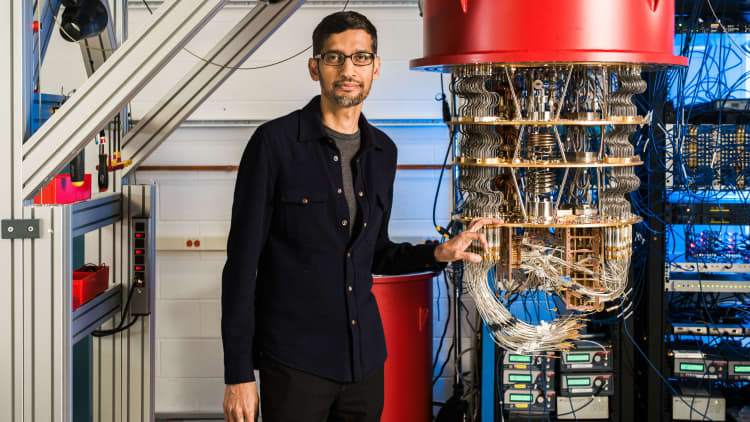
While AI dominates the headlines, there’s another breakthrough tech rising behind the scenes.
It’s called quantum computing, and it has the potential to completely change the human problem solving process.
For years, quantum has been talked about more like science fiction than science. But now, real progress is being made and companies are racing to integrate usable quantum machines into society. When that happens, we could see major changes in everything from medicine and internet speeds to even insurance.
Here’s how quantum computing could reshape the world and why we should be excited about it.
So What Is Quantum Computing?
Traditional computers use bits that are either 1 or 0. Quantum computers use something called qubits, which can be both 1 and 0 at the same time. This property, along with a few others like entanglement, allows quantum systems to process massive amounts of information all at once.
That’s what gives them their power. They don’t just calculate faster. They calculate in a completely different way, which could unlock solutions to problems we’ve never been able to solve before. To put it in perspective, a problem that might take a classical supercomputer thousands of years to solve could take a quantum computer just minutes.
Companies like IBM are already working on making quantum computers stable, reliable, and ready for real use. Some of those machines may be here within the next few years.
Faster, Smarter Internet
Imagine everyone in your city streaming the same game or movie at once. Your data has to travel across a huge network to reach your screen, and there are tons of possible routes it can take.
Quantum computers could calculate the fastest and most efficient path in real time. That means better streaming, less buffering, and faster internet overall. It could also help companies manage data traffic in ways that traditional systems just can’t handle.
Better Medicine
Drug development is incredibly complex. When scientists create something like an mRNA vaccine, they’re essentially building a set of genetic instructions that teach your body how to fight off a specific virus. Creating those instructions is no simple task. There are trillions of possible combinations of nucleotide sequences, each with slightly different effects on how the body responds. For just a small fragment of an mRNA strand, there can be more possible arrangements than atoms in the known universe.
Even today’s most powerful supercomputers can’t come close to simulating all of those combinations. They simply don’t have the speed or memory to explore the full range of possibilities in a realistic timeframe.
Quantum computers on the other hand could process those complex molecular interactions in parallel, allowing researchers to explore a huge space of possible drug designs at once. That means companies could potentially discover more effective treatments much faster, tailor medicines more precisely to individual patients, reduce side effects, and lower production costs by identifying the most efficient molecular structures early in the process.
Smarter Insurance
Right now, insurance companies use models that rely on broad factors like location, the age of a home, or past claims. While these models provide a general idea of risk, they can’t fully capture the unique features of each individual property or the complex ways different risks might interact over time.
Quantum computing could take things further. It could run billions of simulations that factor in more detailed information, such as the structure of the home, local climate trends, or even small variations in geography. With that level of precision, insurers could make much more accurate predictions and offer pricing that better reflects the true risk of each property.
Some Big Risks Too
As powerful as quantum computing could be, it also poses a significant threat to cybersecurity. That’s because quantum computers could eventually break the encryption methods we currently use to protect sensitive data, like credit card numbers, personal information, and even classified government files. These encryption systems rely on mathematical problems that are difficult for today’s computers to solve, but quantum machines could solve them in a fraction of the time.
To stay ahead of this threat, organizations are already working on developing quantum safe encryption and new security standards that can withstand the power of quantum computing. However, the risk remains that some hackers are already collecting encrypted data today, knowing that they can decrypt it in the future once quantum computers become advanced enough. This “harvest now, decrypt later” threat makes the push for secure encryption more urgent than ever.
Why This All Matters
Quantum computing has been talked about as a future technology for a long time, but that future is getting a lot closer. Once these machines are up and running at scale, they could help us solve problems we can’t even fully imagine yet.
It’s not science fiction anymore. It’s science and it’s happening soon.