

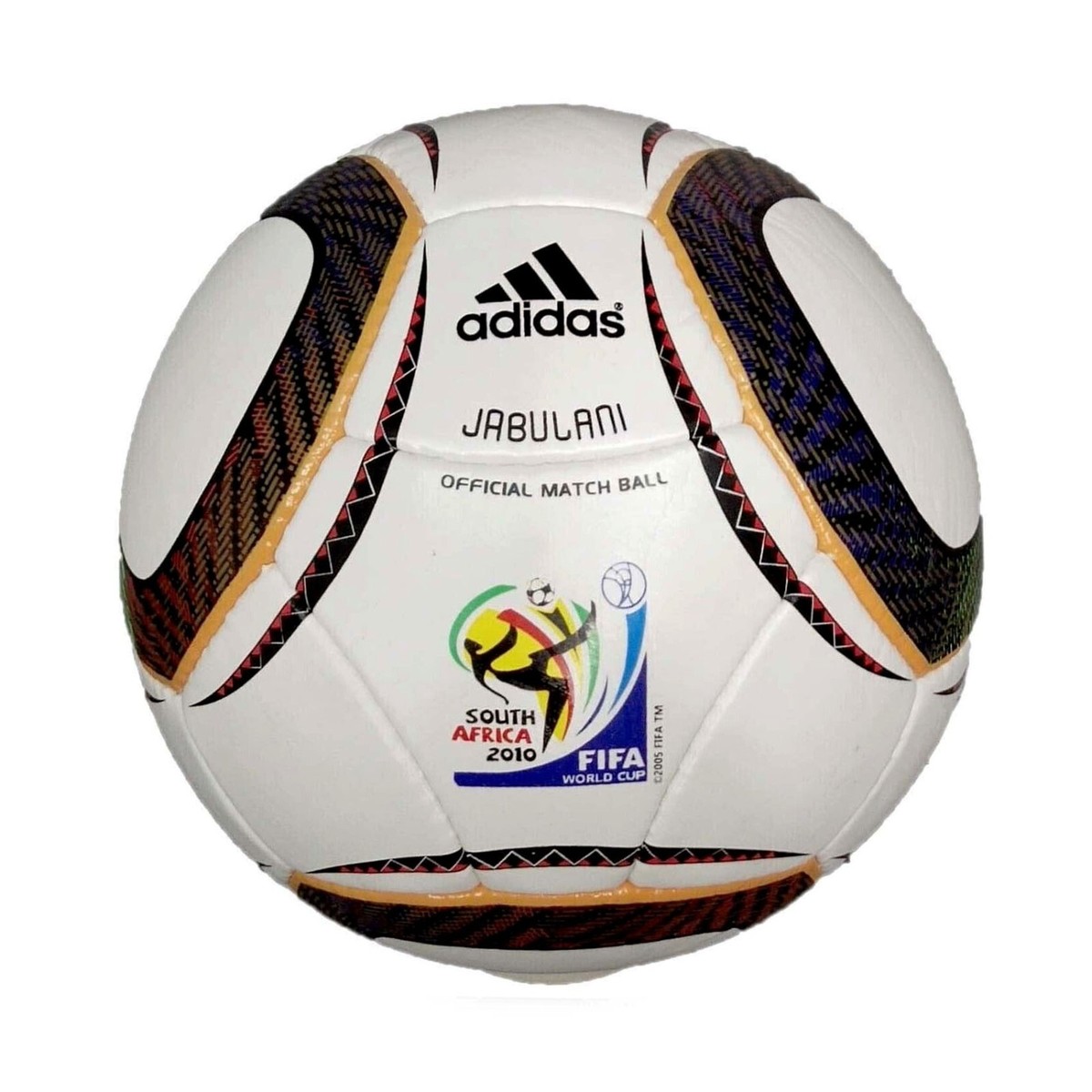
Responsible for the 2010 World Cup, Adidas and its engineers decided to deviate from the usual design of a football. Partnered with Loughborough University, the ball’s eight panel design combined with a smooth surface was intended in making a breakthrough in football aerodynamics.
They were not wrong about that.
In the 55th minute of the 2010 World Cup’s opening match, South Africa v. Mexico, Siphiwe Tshabalala put his nation in the lead by scoring a banger on the top right corner of the net. In addition, Netherlands’ Giovanni van Bronckhorst scored a crucial forty-yard goal against Uruguay in the semi-finals. Was this a showcase of poor goalkeeping or was there something in the football that gave strikers supernatural kicks?
Of course, as mentioned in the title above, the football that I am referring to is the Jabulani.
The Science Behind the Jabulani
Normally, when hitting a football, gravity immediately causes the ball to significantly go downwards. Drag forces such as friction drag (air particles come into contact with the surface of the ball) and pressure drag (air flowing over the ball) are important for causing the ball to lose speed. In other words, a professional striker putting an enormous amount of force onto a regular football still gives the goalkeeper a chance from going into the net.
The Jabulani is different, however.
Instead of using the traditional flat panels, Adidas implemented three-dimensional molded panels to prevent any airflow around the object, reducing friction drag. Furthermore, a traditional football’s thirty-two panels increase the unpredictability of the ball’s trajectory due to the disruption of smooth air flow and so the Jabulani’s thermally bonded eight panel design would ensure that not only would it be less unpredictable but also that the surface is smoother to touch with.
Wait, so why was everybody arguing for its ban?
When taking free kicks or power shots, a traditional football becomes unpredictable when hitting the 20-30 MPH threshold. This causes the airflow to transition from a laminar, predictable motion to a turbulent, chaotic movement, making it difficult for a goalkeeper to save. This is known as the “Knuckle Ball Effect.”
With the case of the Jabulani, the threshold for the ball to “knuckle” or become unpredictable is around 45-50 MPH, a significant increase from the traditional football. This means that goalkeepers during the 2010 World Cup were forced to react to shots that were at least 20 MPH faster than what they were normally used to. These characteristics are what made the Jabulani unique.
And, controversial.
Mixed Feelings
Most professional footballers did not approve of the Jabulani. Notable goalkeepers such as Iker Casillas compared the football to a “beach ball” and Gianluigi Buffon saying that it was “absolutely inadequate.” The World Cup is a special occasion that happens once every four years, so their opinions were warranted. I mean, why would Adidas stray from the traditional football that has been used in the previous World Cups?
Although, some players have adapted to the Jabulani. Brazilian Ballon d’or winner Kaká mentions that the “contact with the ball was just great,” English midfielder Frank Lampard described the Jabulani as “true to hit,” and Germany’s Michael Ballack says “it [Jabulani] does exactly what I want it to.” The most iconic player that fully utilized the Jabulani’s design was Diego Forlan, a Uruguayan striker who helped his nation get third place (against Germany) in the 2010 World Cup. Of course, some claimed that the Jabulani was “remotely controlled,” as his goals were considered supernatural. Nevertheless, the striker cleared up these comments by saying it “took a lot of practice, a lot of training and again a lot of practice.”
Conclusion
After the 2010 World Cup ended, Federation International de Football Association (FIFA) decided to vault the Jabulani forever. The irregularities of the football in comparison to traditional football were just too much for professional players to adapt to. Regardless, the Jabulani’s debut created some of the best goals ever in Football history.

“We got along great!” – Diego Forlan on the Jabulani