
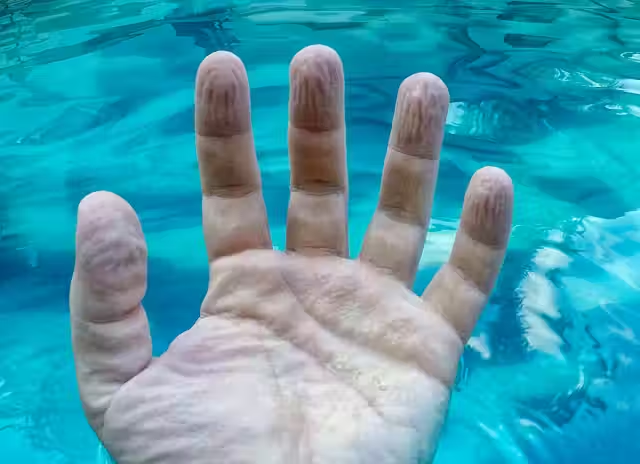
Did you know your fingers wrinkle the same way every time they get wet?
It’s one of those oddly familiar things we notice without really questioning, like how your fingertips turn pruney after a long bath or washing dishes for a bit too long. But as it turns out, there’s more science behind this than you might expect and it’s not just a random quirk of being in water.
A recent study published in The Journal of the Mechanical Behavior of Biomedical Materials found something surprisingly consistent: the pattern of wrinkles that forms on your fingers after water exposure is roughly 94% the same every single time. That’s an oddly high number, considering how organic and spontaneous wrinkling seems. But according to the journal, nothing about wrinkly fingers is random.
So why does this happen?
Most of us probably assume that skin wrinkles when it soaks up water like a sponge, but the real reason is that your body is actually doing something in response to the water. Specifically, your sympathetic nervous system kicks in, the same system that manages your fight-or-flight response when you’re startled or stressed.
Once activated, it causes your blood vessels in the fingertips to constrict, which pulls the skin inward. As that happens, the skin begins to buckle slightly. Not dramatically, but just enough to fold in on itself, forming those little ridges we’ve all seen. It’s kind of like when a tablecloth bunches up at the corners or how loose fabric forms creases. That’s essentially what’s going on—except it’s happening at a microscopic, biological level.
Here’s where it gets even more interesting. The reason the wrinkles form in the same places every time is because they’re following the architecture of your body. Your blood vessels that trigger the wrinkling are stationary and don’t shift around from day to day. So, when they constrict, they do it in the same spots, applying the same pressures. That consistent internal layout creates a repeatable, almost signature-like wrinkle pattern.
The researchers behind the study tested this in a very simple and reproduceable experiment. They asked three volunteers to soak their fingers in warm water for 30 minutes. After that, they photographed the wrinkle patterns on each finger. Then they repeated the exact same process again the next day. Same water temperature, same conditions, same hands. And when they compared the photos? The wrinkle lines and folds lined up remarkably well. On average, there was a 94% match in wrinkle orientation and positioning across the two sessions. That’s impressively consistent, especially for something we usually brush off as a temporary side effect of being wet.
Now, if you’re wondering why the body even bothers to go through all this effort to wrinkle your skin in water, it actually serves a purpose. One that kind of makes sense, once you think about it.
Wrinkled skin provides better grip on wet surfaces. It’s a bit like tire treads in that they channel away water and reduce slipping. That extra traction could’ve been pretty useful for our ancestors, who may have needed to climb wet rocks, hold onto fish, or just move around safely in slippery environments.
What looks like a weird, shriveled fingertip might actually be an evolved biological feature designed to help us interact more effectively with the world around us. So next time you notice your fingers looking like raisins, remember: your body is doing something smart. It’s adapting, responding, and repeating a pattern, one that’s been written in your blood vessels all along.