
Since the beginning of the year, record-breaking leaps in de-extinction have been making headlines everywhere. Colossal Biosciences, one of the biotech companies at the forefront of these breakthroughs, recently announced the successful creation of the woolly mouse and the resurrection of the dire wolf.
Both projects, while greatly differing in nature, underscore Colossal’s bold approach in resurrecting extinct species. The woolly mouse, created from woolly mammoth DNA, served as an efficacy test of genetic manipulation that could breathe new life into creatures that we know only from the fossil record. The project marked a significant milestone, as it succeeded in demonstrating that large volumes of genetic changes are feasible, validating Colossal’s genetic engineering pipeline.
On the other hand, the dire wolf project, in which three pups were born between late 2024 and early 2025, is a true de-extinction effort. The project aimed to bring back an animal very similar to modern wolves, The dire wolf, Aenocyon dirus, a creature that once flourished as an apex predator in North America.
Colossal’s team used ancient DNA from fossils dug up in permafrost to build high-quality genomes. By comparing this ancient DNA to that of modern canids such as wolves, jackals, and foxes, they identified the important genetic variants that would revive the dire wolf’s most important traits.
Rather than searching for a flawless genetic copy, Colossal scientists attempted to create a functional copy of the extinct creature by editing 20 genes in gray wolf cells, altering their genetic code to introduce traits such as the dire wolf’s robust build. The modified cells were cloned and the embryos were transferred into surrogate domestic dogs, which carried the embryos to term.
Two male pups were born in October 2024 and one female pup in January 2025. While these pups are akin to their extinct ancestors in some ways, they are not their exact replicas; rather, they are a hybrid species with the dominant traits of the dire wolf, exhibiting Colossal’s success in genetically engineering living replicas of an extinct species.
Romulus & Remus

Despite being raised in captivity and being cared for by humans, the dire wolf pups, named Romulus and Remus, have shown very little domesticated behavior. Instead, they have shown wild instincts, acting more like their ancestors and less like modern-day dogs. This is one of the most interesting aspects of de-extinction—the possibility of not only reviving the physical traits of an extinct creature but also its natural tendencies.
As the puppies mature, their natural behaviors are likely to become more evident, raising important questions about what their potential role might be in modern ecosystems. While Colossal hopes to use this technology to help endangered species, namely by enhancing genetic diversity, critics argue that the resurrection of extinct species like the dire wolf may not have particular ecological value, particularly since the ecosystems that these animals lived in are now quite different. As such, there is skepticism about the ecological validity and sustainability of such de-extinction efforts.
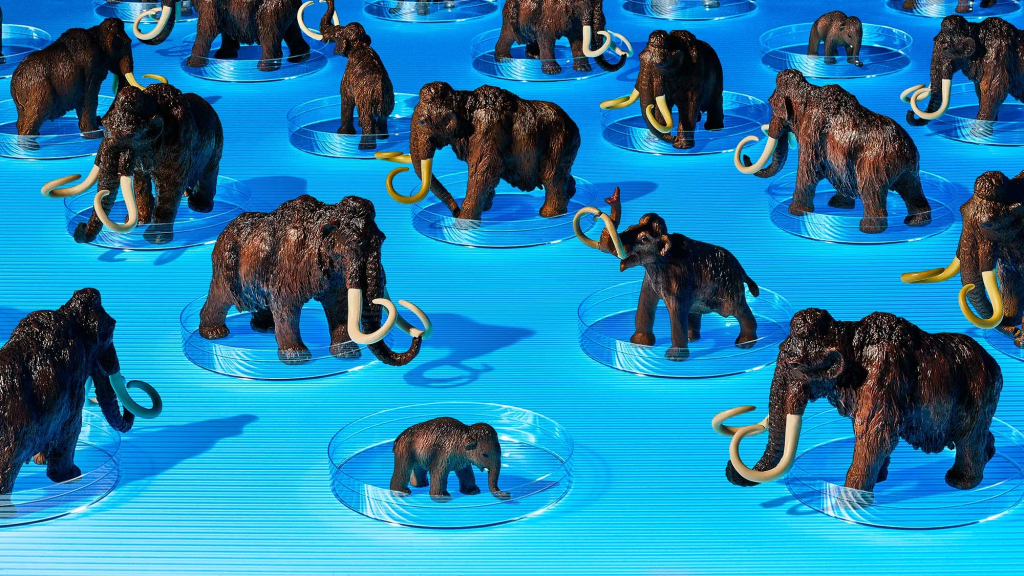
While the mammoth is not yet fully resurrected, its potential resurrection raises necessary questions about the ethical use of genetic engineering. The advocates of de-extinction believe that the technology can be central to addressing the current biodiversity crisis.
As climate change is estimated to drive up to 50% of Earth’s species to extinction by 2050, de-extinction is viewed by some as a mechanism to fight land degradation, loss of diversity, and food insecurity.
License to Kill

But critics caution that de-extinction could be equivalent to a “license to kill,” allowing humans the power to reverse extinction without necessarily considering the long-term consequences. It could foster a dangerous complacency in protecting existing ecosystems and living species, especially if society begins to view de-extinction as a panacea for environmental maladies.
The prospect of resurrecting extinct species also poses an existential challenge to current conservation activities. If we can reverse extinction, then why is there an incentive to preserve existing species? The possibility of de-extinction could discourage the incentive to preserve biodiversity since it shifts the precedence from ensuring the future of existing species to resurrecting those that have already become extinct.
When the public is fixated on restoring the past, we can overlook the pressing needs of still-surviving ecosystems. By investing money in de-extinction attempts, we may be diverting attention from habitat preservation, species preservation, and the prevention of further extinctions. In this sense, de-extinction can unwittingly undermine the very goals of conservation, since it will be increasingly challenging to provide a future for species that are still under threat of extinction.