
3D printing has had a long history from commercial and eventually to public use. 3d printing can be used for a variety of uses, from useful daily tools to commercial products to cosplay and even car parts. This post aims to give an accurate description of the history of 3d printing as well as potential uses to further society as a whole.
The History of 3d printing
There were many people who did extensive research on 3d printing such as Dr Hideo Kodama at the Nagoya Municipal Industrial Research Institute in May 1981, David Jones in 1974 (who actually wrote his research paper as a satirical joke), as well as three French engineers named Alain Le Méhauté, Olivier de Witte, and Jean Claude André in 1984 that applied for a patent but eventually abandoned it for “lack of business perspective”. But the first researcher to apply and receive a patent was Charles Hull, who filed his patent for Stereolithography only 3 weeks after the French Engineers. While Hull may not have been the first to have the idea of Stereolithography he added numerous improvements on top of his own version of the technology. Some of these new features included STL file format and digital slicing, both of which are still extensively used to this day.
The different types of 3d printing and their history:
While SLA (also known as resin printing) was the first type of 3d printing, there have been many versions since then. The next in development was SLS printing, in 1988, Carl Deckard at the University of Texas filed a patent for SLS (Selective Laser Sintering). Unlike Resin printing SLS uses laser to trace and solidify layers of powder polymers. The next type of 3d printing was FDM or Fused Deposition Modeling, which is currently the most well-known and widely used among the general public, was patented in 1989 by Scott Crump who at the same time cofounded the company Stratasys. Stratasys then released their first FDM printer in 1991, the start of 3d printers available to the public. The following year, DTM inc released their first SLS 3d printer, starting the competitive race that would shape the modern 3d printing industry.
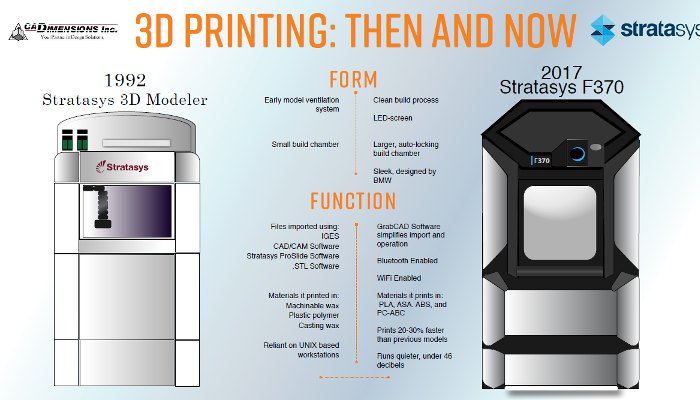
The many uses of 3d printing:
While 3d printers have become publicly available as well as cheap and small, there are many innovations that have been made that have changed and will continue to change the world for the better:
3d printing a… 3d printer? – The ability to self-replicate 3d printers is an amazing tool that has been around for probably a lot longer than you might think. The first self-replicating 3d printer made in 2008 was labeled Darwin, created by Dr. Adrian Bowyer and his RepRap movement, it allowed this 3d printer to create a smaller version of itself, which was available to anyone with the obligation that you would print parts for other 3d printing enthusiasts. These were the first 3d print build kits and allowed the widespread availability of small and effective 3d printers to all.
While these self-replicating machines are astounding, there has been a more recent idea that could change the future as we know it. This idea was created by the members of Project Quine, with only 3 engineers currently working on this project it has made incredible progress in a short amount of time. The concept is a 3d printer that can both build onto itself in order to increase its build height as well as be able to fully print a print in place 3d printer; and with the build height being expandable, this printer could theoretically create a printer larger than itself. Yes, this 3d printer can also print electronics, metal, and even wiring, which would allow the extremely low-cost creation of technology such as pcb boards, and mechanical pieces allowing at home artists to create fully functional complicated machinery. Furthermore, this would allow a printer parent, child relationship that would eventually lead to a printer large enough to print a car, or even a house. This isn’t just the future of 3d printing, it is the future of electronics, mechanics and so many more areas in its own right.
Sources: